 Morus and BUZUD Announce MOU Before Japanese and Singaporean Government Leaders at Japan–Singapore 60th Anniversary Agri-Food Innovation Ceremony
 Pra-Munas APPSI, Sudaryono Diusung Kembali Jadi Ketua Umum APPSI Periode 2026–2031
 Prediksi Harga Minyak WTI Hari Ini: Dupoin Futures Waspadai Koreksi Menuju US$89,28
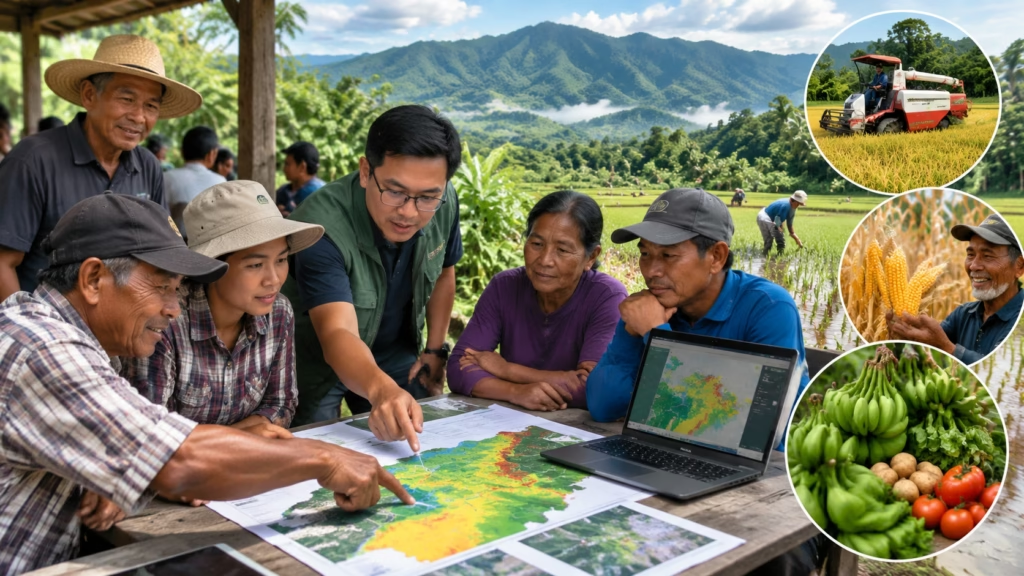
Davao del Norte Test Beds Show How Machine Learning Changes Crop Surveillance
The Department of Agriculture’s push into artificial intelligence-assisted farming entered a new phase in 2026 when Japanese technology provider E-SupportLink began pilot testing AI-powered aerial imaging on three commercial banana farms in Davao del Norte and Davao de Oro. The system does more than capture overhead images; it fuses real-time environmental readings from drones with historical weather records and machine-learning models to forecast pest pressure and flag disease outbreaks before they become visible across entire plantations.
The Davao pilot is undergoing ground verification to confirm that aerial predictions match what agronomists find on the ground. The technology is designed to count plants, estimate production, optimize input use, and detect early symptoms of Fusarium infection—a disease that can devastate banana livelihoods if left unchecked. For growers, the shift is from reacting to damage after it spreads to intervening at the first spectral anomaly in a leaf canopy.
From Reactive Spraying to Predictive Farm Management
DA Undersecretary Cheryl Natividad-Caballero framed the change in operational terms: the value of the system is not the drone itself but the predictive layer attached to it. “We can identify where problems may start before they become bigger issues,” she said, adding that early detection lowers the cost of containment because farmers act before an outbreak crosses farm boundaries.
That economics matters in a crop where disease management often consumes a large share of production budgets. A single delayed detection can mean weeks of intensive chemical control and lost bunches. The AI system compresses that response window by turning aerial imagery into an early-warning map that field teams can act on within days rather than weeks.
Coconut and Sugarcane as the Next Frontier
The DA is already examining how the same aerial-analytics model could serve sugarcane and coconut, two export crops facing stubborn productivity and disease challenges. Agriculture Secretary Francisco P. Tiu Laurel Jr. said the agency wants to test whether earlier detection can protect farmer income in sugar and coconut the way it is expected to in banana. The Philippine Coconut Authority has separately launched its own precision coconut agriculture research, using satellite and drone hyperspectral data to build a national spectral library for coconut identification, pest detection, and yield forecasting—a complementary track that could broaden the evidence base for aerial AI across permanent crops.
The Affordability Question
The pilot has drawn interest from private banana producers, but the DA is careful not to present the technology as a plug-and-play solution for smallholders. Tiu Laurel said the system’s broader impact depends on whether it becomes affordable and accessible not only to large estates but to small farmers. The agency is studying training support through the Agricultural Training Institute and potential funding mechanisms, while E-SupportLink is expected to help train drone operators and establish aerial imaging systems under the proposed cooperation.
For now, the Davao trial is a proof of concept with a clear operational question: whether predictive aerial data can be delivered at a cost per hectare that makes sense for a banana farmer managing five hectares, not just a corporation managing five hundred. The answer to that question will determine whether AI-assisted farming remains a showcase or becomes a standard tool in the Philippine countryside.
You may also like
-
Philippine-made AI hiring platform wins regional award at ASOCIO Digital & AI Awards 2026
-
Filipino resignations peak in July, not after 13th-month pay, study of 275,000 employees finds
-
MOLD Manila Highlights Ultraformer III for Non-Surgical Facial Lifting and Skin Tightening
-
Casino Plus makes history with Evolution’s first-ever offline collaboration in the Philippines
-
Call for Photo Entries for ‘TPSW 2026’, Celebrating Volunteerism in Asia