 AHEAD Education Group Opens 90,000 Free Review Slots for Public High School Students, Launches ReviewLab for PUP, UP Entrance Exams
  Cebuana Lhuillier Puts Convenience at Customers’ Fingertips with Cash Accepting Machines
  Sydney gears up for Christmas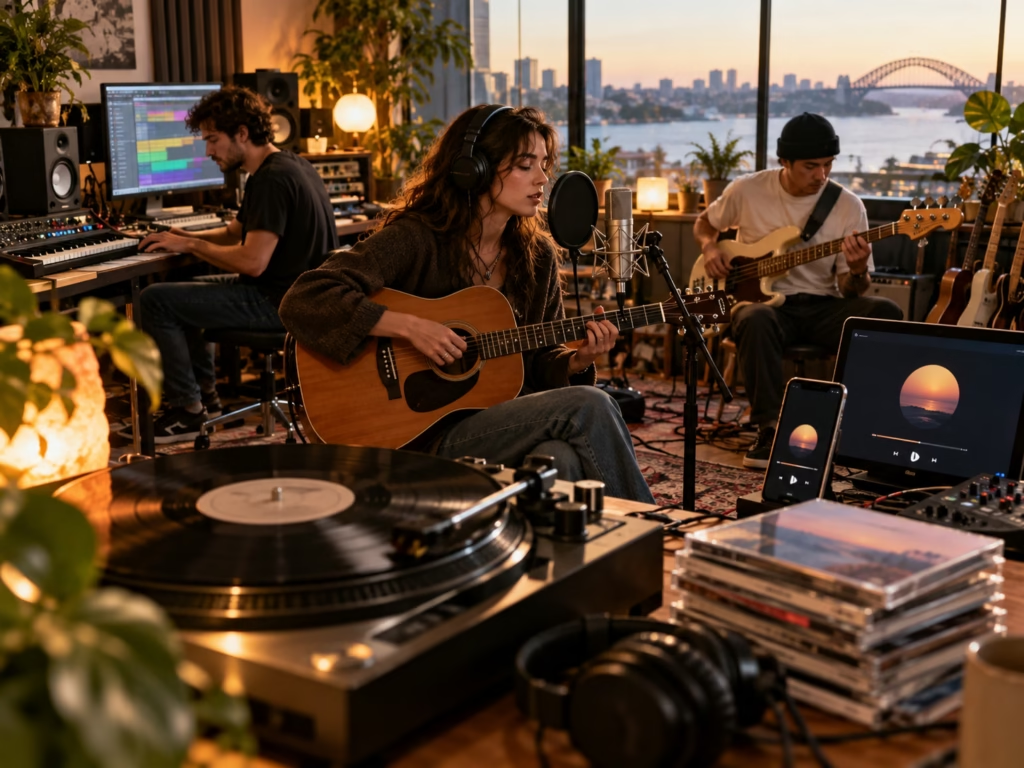
A Seventh Consecutive Year of Expansion
Australia’s recorded music sector has defied global headwinds to post its seventh straight year of wholesale revenue growth, according to figures released by the Australian Recording Industry Association (ARIA). Wholesale sales climbed 1.4% in 2025 to reach $727 million, a result that underscores the resilience of local consumer demand even as streaming markets worldwide begin to plateau.
The tempered pace of growth mirrors patterns observed in other mature markets such as the United Kingdom and parts of Europe, where subscriber acquisition for streaming platforms has started to stabilise. Yet Australia’s performance remains notable for its consistency: seven years of uninterrupted expansion is a rare achievement in a global industry still navigating post-pandemic volatility.
Streaming Dominance and the Physical Music Revival
Subscription streaming services continue to form the backbone of the Australian market. They generated $517 million in 2025, representing 71% of total revenue. When ad-supported and video streaming are included, digital formats accounted for $659 million, or 90.7% of all industry income.
What makes the 2025 data particularly compelling, however, is the resurgence of physical formats. Physical music revenue jumped 11% year-on-year to $67.9 million. CD sales climbed 29.6% to $21 million — their highest level since 2021 — with more than 1.5 million units sold. Vinyl maintained its steady trajectory, growing 4.1% to $46.3 million and accounting for over two-thirds of physical revenue.
ARIA CEO Annabelle Herd framed these results as evidence of a deeper fan connection. “While the pace of growth eased last year as streaming markets mature, the surge in physical sales shows that fans want to engage with music in deeper, more tangible ways,” she said.
Structural Challenges Beneath the Surface
Despite the headline growth, significant structural challenges persist. Breaking new Australian talent in an increasingly crowded global marketplace remains difficult. Herd acknowledged that while artists such as Amyl and the Sniffers, Ninajirachi, Dom Dolla and Troye Sivan have achieved international breakthroughs, “earning a living as an artist has never been harder”.
The industry body has renewed calls for policy reform, including the removal of the long-standing 1% cap on radio royalties and the ABC’s fixed pricing model. ARIA argues that these changes would better support local artists and signal stronger institutional backing for Australian music at home.
AI as a Defining Industry Issue
Looking ahead, ARIA has identified artificial intelligence as a defining issue for the global music business. Herd noted that AI presents genuine opportunities for the industry but insisted that “these opportunities must be built on a foundation of consent, transparency, and fair compensation for artists and rights holders”.
ARIA has committed to pushing back against any weakening of Australia’s copyright framework, a stance that aligns with broader industry sentiment. The organisation’s priorities for the coming year centre on growing audiences for Australian music, advocating for fairer remuneration structures, and ensuring that local artists can compete on a level playing field in an increasingly algorithm-driven discovery ecosystem.
The Road Ahead
Australia’s recorded music industry enters 2026 with a foundation of sustained growth and a clear policy agenda. The maturity of streaming presents both a stabilising force and a warning sign: without continued investment in artist development, export infrastructure, and copyright protections, the gains of the past seven years could prove fragile. The next chapter will depend on whether industry and government can align on reforms that match the ambition of Australia’s creative talent.
You may also like
-
Sydney gears up for Christmas
-
How to Study for Year 12 Exams 2026: Fix Common HSC, QCE and VCE Mistakes
-
Australian Platform BuildPilot Brings Homeowners, Builders and Building Services Together in One Digital Destination
-
OSAKA COMEDY FESTIVAL 2026 Draws 73,658 Attendees; Cirque du Soleil Holds First Clown Auditions in Japan
-
From Margins to Mainstream: 350 health leaders tackle the next frontier of voluntary assisted dying care