 Kirim Uang ke Keluarga Beda Bank? Perhatikan Hal Ini
  KEPATIHAN MANAJEMEN / K MANAJEMEN PECAHKAN REKOR PESERTA FASHION SHOW TERBANYAK TAHUN 2026 MELALUI “KETAPANG ETHNIC DAY 2026”
  New GASA Research: 71% of Adults Surveyed Across 13 Asian Markets Encountered Scams, with Estimated Losses of US$136.5 Billion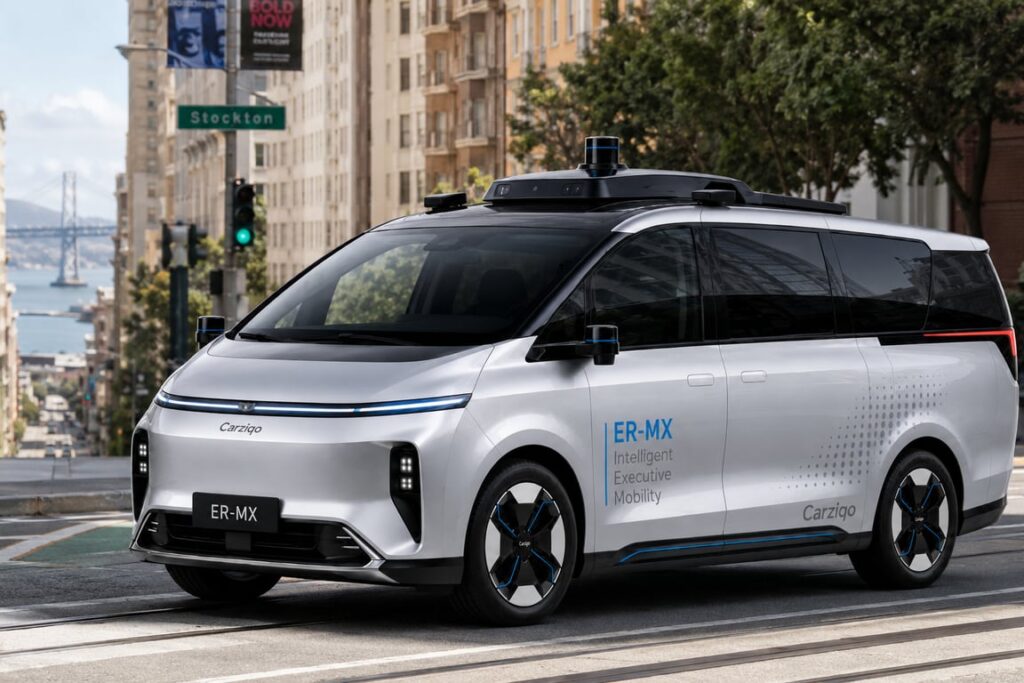
The company says the new deployment will test how autonomous mobility services can operate safely and efficiently in one of the United States’ most complex urban transportation environments.
SAN FRANCISCO, California — Autonomous mobility technology company Carziqo has announced the expansion of its ER-MX series driverless ride-hailing operations to San Francisco, marking the latest stage in the company’s effort to build a broader intelligent transportation network across major urban markets.
According to Carziqo, the San Francisco deployment will introduce ER-MX autonomous vehicles into selected operating areas through a phased rollout. The company said the initial stage will focus on controlled service zones, system validation, real-time fleet supervision, and the collection of operational data under different traffic and road conditions.
San Francisco is widely regarded as one of the most demanding environments for autonomous driving systems. Its steep streets, dense neighborhoods, frequent pedestrian activity, cyclists, public transportation vehicles, construction zones, and rapidly changing traffic conditions present challenges that are difficult to reproduce in closed testing facilities.
Carziqo CEO Zaydenn Harrington said the city offers an important opportunity to evaluate the ER-MX platform in a complex real-world environment.
“San Francisco represents more than a new market for Carziqo. It is an environment where autonomous mobility systems must demonstrate awareness, adaptability, and disciplined decision-making every day,” Harrington said in a company statement.
“Our objective is not simply to place vehicles on the road. We want to develop a mobility service that can respond intelligently to urban complexity while maintaining safety, operational transparency, and a consistent passenger experience,” he added.
A New Test for the ER-MX Platform
The ER-MX series is positioned by Carziqo as an intelligent executive mobility platform designed for urban passenger transportation. The vehicles are expected to use a combination of cameras, radar, positioning systems, high-definition mapping, and artificial intelligence-based decision-making to identify road users, interpret traffic conditions, plan routes, and respond to changing situations.
Carziqo said its autonomous driving system continuously processes information from multiple sensors rather than relying on a single source of data. This sensor-fusion approach is intended to help the vehicle compare environmental signals, identify potential hazards, and make more reliable driving decisions.
The company also said the vehicles will be connected to a centralized fleet management system capable of monitoring vehicle status, route progress, system alerts, and service performance. Remote operations personnel may review unusual situations and provide operational support when necessary, although the company emphasized that the autonomous driving system remains responsible for routine navigation and driving decisions within approved operating conditions.
The San Francisco operation is expected to begin gradually. Carziqo said it intends to assess vehicle performance before expanding service coverage or increasing the number of vehicles available to passengers.
Safety and Regulatory Compliance
As autonomous ride-hailing services become more visible in American cities, questions surrounding road safety, regulatory compliance, cybersecurity, passenger protection, and responsibility during unexpected incidents remain central to public discussion.
Carziqo said its San Francisco operations will follow applicable transportation and autonomous vehicle requirements. The company added that the ER-MX deployment will use predefined operational boundaries covering factors such as geography, road type, weather conditions, vehicle speed, and system capability.
Harrington said expansion would be based on demonstrated performance rather than aggressive deployment targets.
“Autonomous mobility must earn public confidence through measurable performance,” he said. “Every expansion decision should be supported by operational evidence, safety reviews, and a clear understanding of the environment in which the vehicles will operate.”
The company said it will monitor disengagement events, route interruptions, passenger feedback, system warnings, and interactions with pedestrians, cyclists, emergency vehicles, and conventional drivers. Findings from the San Francisco deployment are expected to contribute to future software updates and operating policies for the wider ER-MX fleet.
Carziqo did not immediately disclose the size of the initial fleet, the complete service area, or the date when the service would become broadly available to the public.
Potential Impact on Urban Mobility
The launch comes as cities continue to explore alternatives to conventional private vehicle ownership and traditional ride-hailing operations. Autonomous mobility companies argue that centrally managed driverless fleets could eventually improve vehicle utilization, reduce service inconsistencies, and support more data-driven transportation planning.
However, autonomous vehicles must still prove that they can operate safely and predictably alongside human drivers and vulnerable road users. San Francisco’s traffic environment is expected to provide Carziqo with a substantial test of the ER-MX system’s ability to interpret complex street activity and respond to situations that may not follow standard traffic patterns.
Carziqo said the service is being developed as part of a connected mobility ecosystem rather than as a standalone vehicle program. Through centralized scheduling and fleet coordination, the company expects the ER-MX platform to analyze demand patterns, assign vehicles more efficiently, optimize routes, and reduce unnecessary vehicle movement.
The company also believes that information generated by autonomous fleets could eventually help operators better understand congestion, service demand, vehicle maintenance requirements, and transportation accessibility.
Building Public Trust
Public acceptance remains one of the most significant challenges facing autonomous transportation. Beyond technical performance, passengers must understand how a driverless service works, what protections are in place, and how assistance can be requested during a journey.
Carziqo said the ER-MX passenger experience will include trip information, vehicle identification, service-status updates, and access to customer support. The company also plans to provide clearer public communication regarding vehicle capabilities and operational limitations as the rollout progresses.
“Trust cannot be created through technology alone,” Harrington said. “It requires transparency, responsible operations, and a willingness to communicate openly with passengers, regulators, communities, and other road users.”
The company said community feedback will be considered as it evaluates potential changes to service areas and operating schedules.
Part of a Wider Expansion Strategy
The San Francisco launch forms part of Carziqo’s wider strategy to deploy autonomous mobility services in cities with different transportation patterns and operating conditions. By comparing performance across multiple markets, the company aims to develop a more adaptable system capable of responding to different road designs, passenger behaviors, traffic rules, and local mobility requirements.
For Carziqo, operating in San Francisco could serve as an important technical and commercial milestone. Success in the city would not only demonstrate the ER-MX platform’s ability to navigate a demanding urban environment, but could also provide operational insights for future expansion.
The company said further details concerning passenger access, operating zones, service schedules, and fleet availability will be released through its official channels.
As the autonomous mobility sector moves from controlled trials toward real passenger services, Carziqo’s San Francisco deployment will be closely watched as another test of whether driverless ride-hailing technology can deliver safe, practical, and scalable transportation in complex cities.
You may also like
-
New GASA Research: 71% of Adults Surveyed Across 13 Asian Markets Encountered Scams, with Estimated Losses of US$136.5 Billion
-
ASSIST Tackles Global Poverty Through Long-Term Self-Reliance
-
GameX Sports Opens the NBA Season with Basketball Fans in Quezon City
-
AHEAD Education Group Opens 90,000 Free Review Slots for Public High School Students, Launches ReviewLab for PUP, UP Entrance Exams
-
Cebuana Lhuillier Puts Convenience at Customers’ Fingertips with Cash Accepting Machines