 Bank Raya Ajak Nasabah Hitung Jejak Karbon Lewat Raya Jejak Hijau
 More than 580,000 Australian children subjected to online sexual approaches each year: new research
 New BigSeller-AutoCount Integration Links Marketplace Orders with Accounting Records in Malaysia
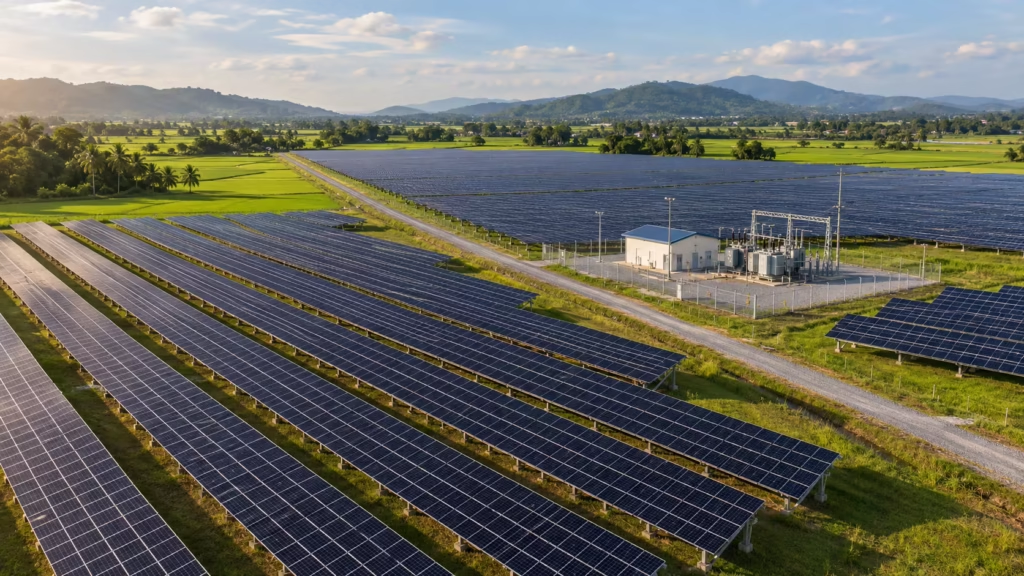
The 600 MW That Could Redefine Malaysia’s Export Role
On paper, the numbers are straightforward: Ditrolic Energy is leading a 600 MW solar project in Johor to export electricity to Singapore, while Sembcorp Utilities has a 300 MW solar farm in the same state awaiting clarity on cross-border sales. In practice, these projects represent a fundamental shift in how Malaysia participates in the regional electricity market. The country is moving from a domestic-only renewable energy market to a cross-border clean electricity supplier.
The SJREC project—a US$6 billion solar and battery storage development in Johor co-developed by Ditrolic Energy and Permodalan Darul Ta’zim—has received Conditional Approval from Singapore’s Energy Market Authority to import up to 600 MWac of renewable electricity. The project is designed to connect Johor’s renewable resources with both domestic businesses and Singaporean consumers.
The Infrastructure Beneath the Headlines
Cross-border electricity trade is not only about generation. Malaysia currently has a one-gigawatt interconnection with Singapore, and a new development for up to two gigawatts of additional capacity saw marine surveys along the proposed route in October 2026. The project is being developed by Singapore Energy Interconnections, SP PowerAssets, and Tenaga Nasional Berhad.
A separate proposal for up to one gigawatt of subsea power cable from Sarawak to Singapore or Peninsular Malaysia has been discussed but has not yet firmed up. If realised, it would turn Sarawak’s hydro-rich interior into an export-oriented generation base, linking the state’s 10 GW capacity ambition to regional demand centres.
The LTMS-PIP and the Multidirectional Trading Layer
The Lao PDR–Thailand–Malaysia–Singapore Power Integration Project has entered a more complex phase. Phase Two will increase electricity trade from up to 100 MW to a maximum of 200 MW, enabled by multidirectional power trading under which additional renewable electricity from Malaysia will be transmitted to Singapore. Malaysia also acts as a wheeler for up to 100 MW of electricity sales from Lao PDR to Singapore using its existing interconnection infrastructure.
This wheeling role is strategically important. It gives Malaysia operational experience in cross-border scheduling, settlement, and reliability management—capabilities that become essential as the ASEAN Power Grid moves toward a fully integrated regional market by 2045.
Energy Exchange Malaysia and the Governance Gap
Malaysia’s cross-border renewable energy trading platform, Energy Exchange Malaysia (ENEGEM), has begun exporting renewable energy to Singapore. But the governance framework is still catching up with the commercial ambition. Deputy Prime Minister Fadillah Yusof has argued that the ASEAN Power Grid must move beyond ambition into implementation, with tangible infrastructure that supports electricity trade and improves supply resilience.
The unresolved questions are practical: how are transmission costs allocated across borders, how are renewable energy certificates tracked and traded, and what happens when a exporting country’s domestic demand competes with export commitments? These are not technical footnotes. They determine whether cross-border projects can reach financial close.
What Johor’s Corridor Signals to Investors
Johor is becoming a test case for whether Malaysia can simultaneously serve domestic data centre demand and export clean electricity to Singapore. The state’s proximity to Singapore, available land, and grid connectivity give it a first-mover advantage. But the same grid constraints that affect Peninsular Malaysia’s solar build-out apply here: transmission capacity, land acquisition, and permitting timelines.
For investors, the cross-border angle adds a new revenue dimension. Export-linked projects can access Singapore’s willingness to pay for clean electricity, which may be higher than domestic tariffs. That premium, if structured predictably, could improve project economics and accelerate Johor’s solar pipeline.
You may also like
-
New BigSeller-AutoCount Integration Links Marketplace Orders with Accounting Records in Malaysia
-
Mimin and YTL AI Labs Partner to Bring Smarter Voice AI Experiences to Malaysian Businesses
-
Sanct Social sets up at a Jakarta cultural festival for a day, its fourth event since the app launched
-
Malaysia’s E-Commerce Income Reached RM1.29 Trillion: What Growth Means for Seller Operations
-
TikTok Shop Malaysia Updates Campaign Eligibility: What Sellers Should Fix Before 12.12