 Australian Platform BuildPilot Brings Homeowners, Builders and Building Services Together in One Digital Destination
  Bank Raya Perkuat Inovasi dan Layanan Digital, Dukung Percepatan Inklusi Keuangan Digital di Indonesia
  Komitmen Terapkan K3, PT Railink dan Sudin Damkar Jaktim Gelar Diklat Pemadam Kebakaran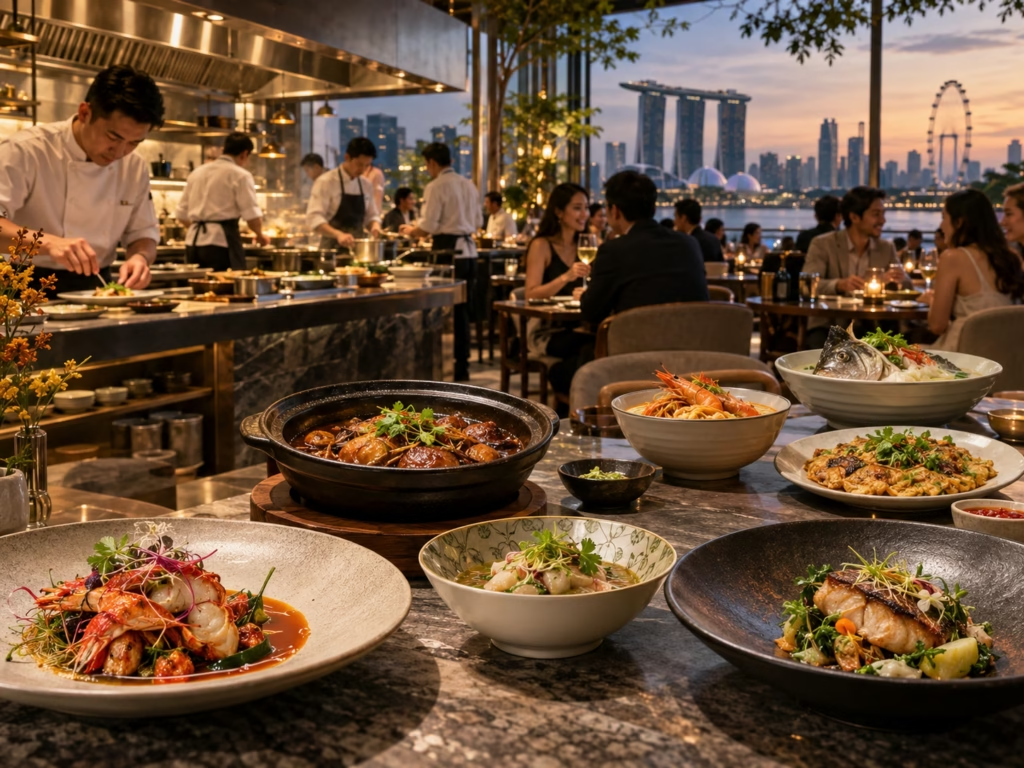
A Market in Structural Realignment
Singapore’s food and beverage landscape in 2026 is undergoing what industry analysts describe as a profound structural realignment. The era of predictable mall dining and generic international chains is giving way to a hyper-segmented market defined by selective consumer spending, distinct cultural waves, and highly automated backend operations.
The numbers tell a complex story. According to data from the Accounting and Corporate Regulatory Authority, 2,101 F&B businesses ceased operations in the first seven months of 2026—a 25.1% jump compared with the same period in 2025. Yet in the same period, 2,594 new F&B businesses were registered, indicating that the sector remains dynamic despite elevated churn.
Understanding “Selective Splurging”
Consumer behavior has shifted dramatically in response to economic pressures. Diners are no longer spending freely across all tiers; instead, they are practicing “selective splurging”—punishing the middle ground while rewarding concepts that offer undeniable value, deep narrative authenticity, or hyper-efficient convenience.
Traditional mid-tier mass-market dining and generic food courts have faced noticeable headwinds, marked by a contraction in market share. The Restaurant Association of Singapore recorded a 5.3% year-on-year drop earlier in 2026, with total F&B sales in June slipping 2.3% year-on-year to $1.51 billion.
Yet two distinct formats are pulling ahead: casual luxury concepts that deliver exceptional culinary craft in accessible settings, and health-conscious offerings that integrate plant-based iterations of local staples and functional, adaptogen-infused beverages.
The High-Churn Reality and Strategic Consolidation
Industry observers characterize Singapore’s F&B sector as a “high-churn industry” marked by continued consolidation, elevated churn, and market rationalisation. As Tan Hsien Wei, senior lecturer at Temasek Polytechnic’s School of Business, explains: “These figures point to a highly dynamic market, with established businesses exiting or rationalising their operations even as new concepts continue to enter.”
High closure numbers should not be interpreted as evidence of sector decline. Consolidation—whether through rationalizing branch networks or closing underperforming locations—can be a deliberate strategic move to safeguard brand health amid rising costs and intensifying competition. Competition has intensified as diners have more choices across price points, cuisines, and formats, while social media has accelerated the speed at which dining trends emerge and fade.
The Hyper-Regional Chinese Expansion
One of the most significant structural shifts in 2026 has been the evolution of Chinese cuisine in Singapore from generic mala hotpot ubiquity to hyper-specific regional niches. Driven by market saturation in domestic mainland markets, major Chinese F&B conglomerates have weaponized Singapore as their primary international springboard.
The consumer palate has matured accordingly. Diners are moving toward the sharp, fresh-chili heat of Hunanese cuisine and the complex, sour, fermented profiles of Guizhou and Yunnan cooking. Micro-regional comfort concepts—from Shenyang-style claypot barbecue to Fujian artisanal dining and Shaanxi hand-pulled street noodles—are capturing everyday dining traffic by offering authentic regional specialties with efficient operations.
The Wellness Imperative
Wellness has transitioned from a niche marketing buzzword to a baseline operational requirement. Menus across Singapore have systematically integrated plant-based iterations of local staples, low-glycemic-index carb alternatives, and functional beverage pairings designed to capture an increasingly health-literate demographic.
This shift reflects broader societal changes in Singapore, where consumers are increasingly educated about nutrition, sustainability, and the connection between food and well-being. F&B operators who fail to address these preferences risk being left behind as diners gravitate toward brands that align with their values and lifestyle choices.
Looking Ahead: Resilience Through Adaptation
Despite challenging conditions, the long-term trajectory of Singapore’s F&B market remains positive. The foodservice market is projected to grow from USD 28.92 billion in 2025 to USD 34.24 billion in 2026, with forecasts reaching USD 79.73 billion by 2031 at an 18.42% compound annual growth rate.
The businesses that will thrive are those that can adapt to the new consumer landscape—embracing technology to optimize operations, offering authentic value propositions that resonate with discerning diners, and finding the sweet spot between quality and accessibility that defines the casual luxury era.
For ongoing market analysis and industry updates, the Restaurant Association of Singapore provides regular F&B Services Index reports tracking sales performance across segments.
You may also like
-
Sanct Social releases Episode 7, a short film about keeping two weeks with family close after the flight home
-
What Does Hospitalisation Really Cost in Singapore? It’s More Than Just the Medical Bill
-
Friends on Sanct Social are added by meeting in person: Episode 6 follows one day in Jakarta with friends from Singapore and Malaysia
-
Dorothy International 2026 Autumn Auction Highlight – Mountains Across the Scroll: Yun Shouping’s Ten Thousand Miles of Mountains and Rivers
-
Singapore Tidal Energy 2026: NUS Study Finds 22% Potential, Government Says Under 1%