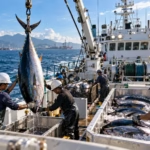
 The RM100 Million Gamble: How Malaysia’s 13th Malaysia Plan Is Rewriting the Rules of Deep-Sea Fishing
  Sabah’s Blue Economy Gambit: Downstream Value and the Regional Tuna Hub Vision
  BRI BO Gading Boulevard Peringati Hari Kesaktian Pancasila dengan Khidmat dan Penuh Semangat Kebangsaan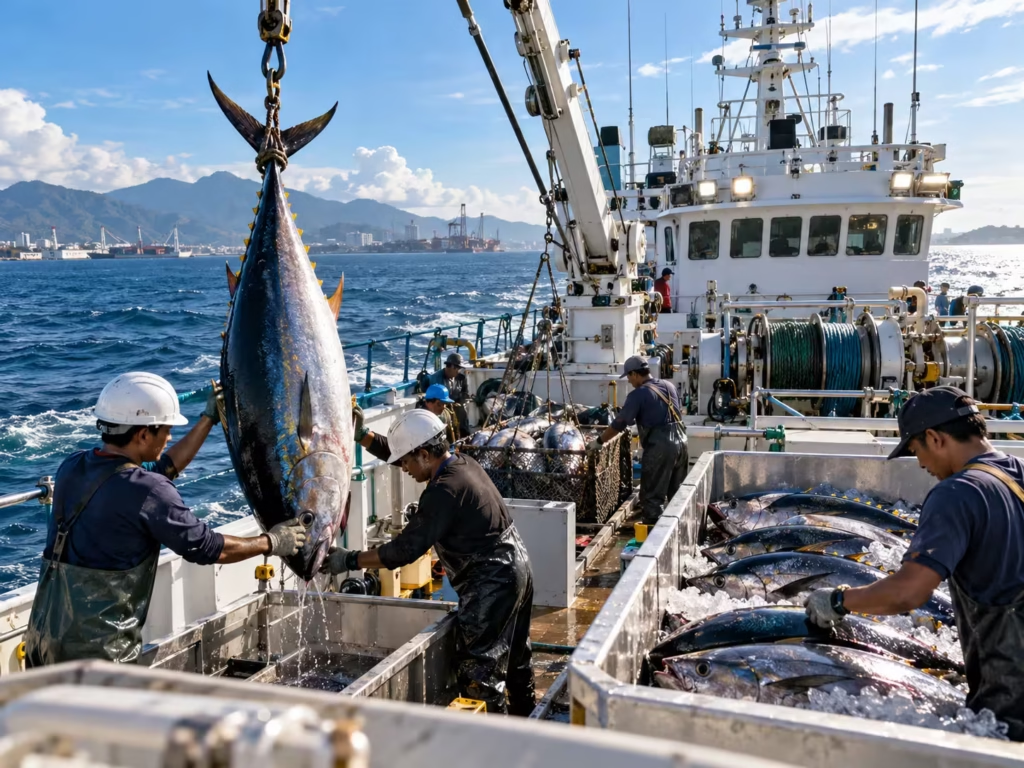
A Financing Scheme Unlike Any Before
Malaysia has never before committed such concentrated financial firepower to its deep-sea fishing sector. Under the 13th Malaysia Plan (RMK13), the Fisheries Development Authority of Malaysia (DOF) has approved a RM100 million financing scheme spanning 2026 to 2030, specifically designed to enable Zone C2 deep-sea licence holders and Zone C3 tuna vessel operators to acquire new vessels or upgrade existing ones through mechanisation and automation.
This is not a subsidy programme in the conventional sense. It is a structural intervention aimed at converting Malaysia’s fishing fleet from a collection of ageing, labour-intensive vessels into a modern, technology-enabled maritime force. The scheme’s architects have been explicit about the objective: improve productivity, enhance catch quality at landing points, and build a sustainable pipeline of skilled maritime professionals capable of operating in increasingly competitive oceanic environments.
The Strategic Logic Behind the Allocation
The numbers tell a story of untapped potential. Malaysia’s exclusive economic zone (EEZ) spans more than 350,000 square kilometres, yet the nation’s deep-sea catch has historically underperformed relative to its maritime endowment. The government’s diagnosis is straightforward: the fleet is too old, too small, and too technologically conservative to compete effectively in the Indian Ocean and South China Sea tuna fisheries.
The Tuna Industry Development Strategic Plan 2021–2030, which the RMK13 allocation directly supports, sets targets that would have seemed fanciful a decade ago. The plan envisions annual oceanic tuna landings of 50,000 metric tonnes, generating an estimated economic value of RM1.8 billion, and creating over 1,000 new employment opportunities. A separate RM17 million allocation has been earmarked specifically for tuna industry development in the South China Sea and Sulawesi Sea, reinforcing the geographic focus of these ambitions.
Sabah and Labuan: The Geographic Centrepiece
The implementation architecture for these initiatives relies heavily on coordination with state governments, particularly Sabah and the Federal Territory of Labuan. The devolution of deep-sea fisheries licensing authority to the Sabah state government on 4 December 2021 represented a significant shift in governance philosophy—moving decision-making closer to the communities and ecosystems most directly affected.
The rezoning of fishing areas and the development of maritime Technical and Vocational Education and Training (TVET) programmes form complementary pillars of this decentralised approach. The logic is compelling: licensing decisions made in Kota Kinabalu are more likely to reflect the operational realities of fishermen operating in the Sulawesi Sea than decisions made in Putrajaya. Similarly, TVET programmes designed in collaboration with local fishing communities are more likely to produce graduates who actually pursue careers in the sector.
The Transition from Low-Value to High-Value
The broader policy context in which this financing scheme operates reflects a deliberate strategic pivot. As articulated in government policy documents, Malaysia is transitioning “from low-value-added activities to a more competitive sector,” with focus now directed toward deep-sea fishing and the production of downstream products based on marine resources.
This transition is not merely rhetorical. The RMK13 framework explicitly emphasises the growth of strategic industries within a sustainable and competitive blue economy, positioning fisheries as a central component of national economic resilience rather than a peripheral rural livelihood activity. The inclusion of fisheries within the blue economy paradigm signals an understanding that the sector’s future is inseparable from broader questions of maritime security, technological innovation, and international trade competitiveness.
What Success Would Look Like
If the RM100 million financing scheme achieves its objectives, Malaysia’s deep-sea fishing sector by 2030 would look fundamentally different from its current configuration. A modernised fleet of Zone C2 and C3 vessels would be operating with greater efficiency, lower fuel consumption per tonne of catch, and improved catch quality that commands premium prices in international markets. Tuna landings would be consolidated at purpose-built facilities in Sabah and Perak, feeding into downstream processing operations that capture value currently lost to foreign processors.
The alternative scenario—continued underinvestment and technological stagnation—would see Malaysia’s deep-sea catch decline further as ageing vessels are retired without replacement, fishing communities lose employment opportunities, and the nation’s maritime economic potential remains unrealised. The RM100 million allocation represents a wager that the first scenario is achievable. Whether that wager pays off will depend on execution as much as ambition.
You may also like
-
Sabah’s Blue Economy Gambit: Downstream Value and the Regional Tuna Hub Vision
-
As AI Reshapes Society, Malaysia to Host AACM 2026 to Explore the Future of Humanity
-
ICW AND BUILDXPO MALAYSIA 2026 PREVIEW: NEW PLATFORMS, IDEAS AND INNOVATIONS TAKE CENTRE STAGE
-
Three lessons from Hangzhou, and one potential partnership to follow up: Sanct Social founder on China’s Global Digital Trade Expo
-
Monash University Malaysia Leads Triple Alliance’s Flagship Mental Health Initiative To Strengthen Student Wellbeing